Showing posts with label sustainability. Show all posts

Saturday, October 04, 2014

Permaculture: The Dynamic Clock

So, I’ve taken on helping to plan next winter’s Permaculture Design Course, which has made me so busy that I haven’t had much time for blogging. But, here I am, hoping that a new post will kick my rear into gear so I can share some of my summer accomplishments with you.

I feel like I talk about permaculture a lot on the blog. The course has kind of taken over my life, which I have mixed feelings about. Frankly, I didn’t anticipate having to do so much advertising, which I hate. But I loved the course last year and I’d really like to see another one happen this year, so you do what you have to.

Over the past year, I kind of realized why I like permaculture so much: it really teaches you to look at your world as a whole, not just individual parts. Our environment is basically a constant feedback loop, and each piece interacts with others in ways we don’t necessarily see. It’s like the workings of a clock, only more dynamic, because the way an element interacts with others may actually change the way it behaves.

From the standpoint of a meteorologist, it’s microclimatology at its best. Each leaf of a tree reflects some light, absorbs some light, absorbs some gases and emits others. Standing under a tree is a cooler, more humid environment than in a sunny spot, and a forest will be cooler than a field. And then there’s the biological aspect – the shady cool forest attracts other plants and animals than you would see in the meadow.

From the standpoint of a project manager, permaculture embodies the idea of the perfect system. All waste is used, output is maximized, and effort is minimized. And we can actually design the system to work that way. It’s not just luck, it’s planning, observation, and thought, with creative design thrown in.

Finally, from the standpoint of a human being, permaculture integrates human interaction into the environment in a positive way. It shows us how to pull the pieces together so that we’re working within the system, not just acting like we’re running a simulation or viewing from a remote planet.  

I’ve read the books and the websites, but last year I felt like I was missing the pieces to put it all together. And that’s what the design certificate provided. I was so proud of the final project my group pulled together. Even more importantly, I’ve met some great friends who I can rely on for advice and support as I try new things. Permaculture is like a well of knowledge that I’ve just taken a sip from, and I can see the rest of the water still shimmering down below. But at least now I have a bucket to go back for more.

Sunday, May 11, 2014

Permaculture Class: The Grand Finale

This weekend was the final weekend of my Cold Climate Permaculture Class out in Palmer. This is the class I've been taking once a month since October, and I've had two major projects for. We had to deliver our final project today, and oh my gosh, I was so freaking proud of what we had done.

Our final design. Drawing by Ray Nabinger, color by Alicia Nelson.

I had a fantastic group where everyone contributed equally. We met at Bridget's lot (the place we were designing) almost every week for the past month to get everything put together. We ended up with 4 or 5 drawings, about 10 overlays, multiple spreadsheets, and a 53 page report. Now, before you end up too shocked, most of those 53 pages were illustrations. But still, 9300 words is a lot of work for something you're doing for "fun".


I got a design certification!
...which I will need to pay off my new library.


But it was fun! We really enjoyed meeting at the lot every time. The last time, Bridget brought the rocket stove she had built in one of our classes, and we cooked a meal of Alaskan-grown cow, nettles and onions over a fire made out of twigs. Talk about eating locally! It was amazing.

Fievel and Tilly fighting over a locally grown bone. The big dog sat nearby and behaved.
This class was expensive, true (although very reasonable for the market -- I've seen similar classes offered at $1500 to $2000, where this one was $1200). But I can honestly say I got so much out of it. Of course, I learned a lot of gardening techniques, and a lot about growing things here in AK. I learned how to kill and process a rabbit. I built a rocket stove out of tin cans. I visited 3 local farms and a bio-shelter and learned how they work. But the best thing I got out of it was finding other people who live here and are like me.

I even made friends who like small dogs! (L-R: Fievel, Tamara, me, Tilly)


The group gathering to say their goodbyes.


What do I mean by that? Well, up here, it seems like there are not a lot of people who are interested in the environment. People like their "toys" and their fertilizers. But in the class, I met people who don't think washing and re-using ziplocks is crazy. People who like to talk about the possibilities of owning chickens, and when I say "I'm getting rid of my yard. Planting cherry trees is just the first step", they laugh and nod knowingly. And then they give me tips on where to find cherry trees!

My two tiny cherry trees in my giant yard.

So what am I going to do with my design certificate? I'm not sure, at the moment. I am a certified designer, but I don't feel ready to go out and start charging people just yet. My group and I got along really well, and we'd like to continue that momentum -- so I think we're going to try to design each of our lots for practice. And we have to help Bridget actually implement her plan, so we're going to have work parties. The operative word there is parties. Lots and lots of parties.

4 Fish Design team partying at the lot: (L-R) Ray, me, Bridget, and Alicia

You're probably sick of permaculture by now, but I won't tell you I'm going to stop blogging about it. I will promise you, however, that I'll try to blog about other things in between. Summer is fast approaching, and some of it will be gardening -- but I'll also be hiking, and biking, and camping, and going on a big trip to South Carolina for a family reunion of sorts. So I'll try to keep things interesting. And thanks for reading, friends and family!

Sunday, March 23, 2014

City mouse vs. country mouse

I came across this article on Facebook recently, and I thought it was a good article, and worth a blog post as well, because I have more to say on this topic than would fit in a Facebook status. In case you don't want to read the article (for shame! It's short!), it's an interview with a UVA professor of urban and environmental planning about something he calls "biophilic cities". I don't really want to get into a discussion about what those are because I'm not sure I have enough knowledge to explain it, but I do want to touch on the role of cities in a environmentally conscious society.

One thing I find among the greenies, particularly here in Alaska, is that they can really be down on cities. Cities are viewed as blemishes on the landscape -- they produce enormous amounts of pollution, require a lot of resources, and are basically voids of nature -- or at least, that's the way they're viewed in a place where there's plenty of available land. Here, everyone wants their own plot. Get back to the wilderness!

But in some ways, cities have an opportunity to be more environmentally friendly than someone on an isolated plot of land. Shared living spaces means that we can economize on transportation, heat, and energy needs. In the city, you might be able to walk to your local grocery store, or neighbors house. On a farm or a homestead, you need transportation to do those things.

All this to say, I think the idea of bringing nature to the cities is a good one. Sure, it won't be as natural as real nature! But let's face it, if you live in the country, you want the people in the city to stay there anyway. Why not help find ways to make it more desirable, and less of a burden on the surrounding country side?

Monday, February 17, 2014

Sour Grapes (and Cabbage)

Last weekend, I attended a party on fermentation hosted by the Anchorage Taste Buds club. Because now that I'm an adult, I live life on the wild side. Coincidentally, the prior weekend I had learned about making sauerkraut at my permaculture class.* In fact, I almost didn't attend the fermentation party, because I thought I had already learned everything. What a dumb idea. The party was terrific. Gdaiva (pronounced Godiva, like the chocolate) showed us how she ferments all kinds of vegetables -- not just sauerkraut, but carrots, lemons, olives, you name it.

So what exactly are fermented veggies? Well, essentially, they're pickles. You pack a jar full of of veggies and salt, and depending on the type of veggies, sometimes water, and let it sit on the counter for a week. This encourages natural bacteria to grow, which produce lactic acid, and sour the food (in a good way). The benefit of this method is that it produces good bacteria your body needs -- like the stuff that you think is in yogurt. Unfortunately, shelf stable products are all pasteurized and have lost those beneficial bacteria. Yogurts like Activia actually add those bacteria back in.

We also learned about kefir, which is a bacteria you add to milk to make a yogurt like substance. I didn't try that one because I don't care for yogurt, but I hear there is something called water kefir, which makes a soda like drink. I'm eager to try that. And we learned about kombucha, which is tea fermented from a fungus (mushroom) that also makes a bubbly drink. The sample I had was delicious, just like a carbonated tea! There was enough interest in the drinks alone that I think Gdaiva is going to host another party just for drinks.

My sauerkraut. I actually eat it from the jar, because it is that good. And I also don't want to wash a plate.

So then on Sunday, I tried out the sauerkraut I had started in class a week prior -- and it already had a nice tart flavor! Not quite sour enough for me, but I'll let it sit a couple more days and then put it in the fridge. Who knew sauerkraut was so easy to make?

Now that I know more about it, I'm excited to try fermenting more things -- including pickles! Remember those pickles I made back in the fall? They were delicious, but I used vinegar. Then I purchased fermented pickles in Sydney at a Polish deli, and I was surprised that they tasted exactly like vinegar pickles. If I can get the same taste with beneficial bacteria? Even better! I'll let you know how my experiments turn out.

*So apparently, making sauerkraut is the latest cool thing to do. My friend Erica told me she went to another party where a lady brought her own homemade sauerkraut, and everyone was like "oh, I've been meaning to try that!" I've always been on the edge between "super nerdy" and "early adopter". Except for PBR. I never drank that.

Sunday, November 03, 2013

Water Works

This weekend was the second weekend in my series of Permaculture Design Classes. One of the focuses was water -- how to conserve it and control the flow within your area. Why was I so excited about this?

Did I mention we had another record breaking wet fall?
Right now our class project is to design a new plan for the Matanuska Experimental Farm. But we'll have something put together by early next year and then we'll move on to a more traditional permaculture project -- designing our own space.

First task I need to do is observe. There's a lot of parts to this of course, but regarding the water issue, I need to calculate the contours in my back yard. We learned a couple of techniques to do that this weekend. Here, Cindi and Louisa are making a simple A-frame to use. I hope to get that done soon, before it starts snowing and things get all covered up.


My tentative plan is to take the deepest spot (to the left) and turn it into a pond (obviously I'll have to do some reconnoitering about whether I want to keep the garden boxes there or not). Then, I'll take the line that runs along the fence, and make a gradual slope so that water that collects here runs into the pond. It won't be a stream or part of the pond, but I will plant it with water loving plants to make a sort of rain garden. This will also reduce my mowable area, another goal of mine. I hate mowing.

Sunday, October 06, 2013

Cultivating a Lifestyle

In the spring of 2012, I took an Introduction to Permaculture Class in Australia and really enjoyed it. Ever since then, I've been excited to apply the principles to my own yard and life, but a little overwhelmed on where to start and what resources I have here in Alaska. I've often thought that I would like to take the full design course, which gives you a Design Certificate (you can use the certification as a credential when designing for others), but haven't had the chance yet, partially because it's a two week course and I'd have to take leave. Then this year, a cold-climate specific course opened up in Palmer, on one weekend a month, which is perfect! My first class was this weekend.

What is permaculture, some of you may be asking? I'm glad you asked! Permaculture is the design of a living system that works together harmoniously and abundantly for its components -- plants, animals, humans, and soil. (We had to come up with an "elevator speech" for one of our activities). It's a garden, but it's also incorporating aspects of your home, organics, sustainability, community, integration, self reliance, and no waste!

I'm sorry to say that I don't have any pictures from the weekend, but that should give you a clue that I was really busy and having a good time. We learned a lot, made sheet mulch ("lasagne" mulch), planted a cover crop (a.k.a. "green" manure), did soil tests, observed our environment, and started a major project to present to the Matanuska Experimental Farm sometime in February.

Part of the reason I joined this class is to meet new people who share my interest in organic gardening -- creating a group I can rely on for advice and resources and hopefully make some new friends! I enjoyed meeting everyone, and it was so nice to talk to people about the things I'm interested in (raising chickens, buying fruit trees, composting, etc) without feeling like a weirdo.

So, this was just the first weekend. What now? Well, I need to start some google docs for our project and share them (I'm actually really excited about this!). I want to get a journal and start spending more time observing my yard and my garden. I need to do some compost work, and lay down some sheet mulch for a native plant garden I want to grow next year. And, I need to keep in touch with my classmates so I can develop the community I'm looking for! A lot of work, but I'm definitely excited for the upcoming months.


Saturday, October 29, 2011

Permaculture Musings

I mentioned in my annual Beginning of the Year post that one of the things I wanted to do this year was take a permaculture course. There have been a few opportunities to get involved with some permaculture activities in the community garden, but I wasn’t able to attend any before we left the area. Regardless, I still want to get into a course, although it looks like it will probably be next year at this point.

I’ve been checking out the Milkwood Permaculture site recently; I found them via the Permaculture Research Institute, which is also interesting but preachier. Milkwood is a bit more my speed. I thought this current blog post on urban permaculture design had some really cool ideas.

There are some permaculture design courses coming up in Sydney and I’m going to try to attend one. I’m going to shoot for the introduction to permaculture class in March (the December one is full). What I would really like to do is attend the two week course for a permaculture design certificate in January. Unfortunately, it’s pretty expensive, but more importantly, I don’t really have the leave to do this and our planned Australia/Japan trips. Plus, I’m still a real newbie to these ideas – I haven’t even managed to plan a proper garden yet – so spending a lot of money on a course seems like it’s putting the cart before the horse. Gardening (and permaculture) rely on growth and development, which require time, meaning of course, that I must have patience. I’ve always been very short on that quality, so this is a good exercise in personal growth.

In the meantime, I’m trying to decide what I want to do in the garden/yard at our new house. We will only be living here a short time, so I don’t want to spend too much, and I don’t want to do too much that’s permanent at the risk of irritating the landlord and spending a lot of time and energy on things that are just going to be sprayed with herbicide in 8 months’ time. I still have some time and room to grow a few things though, so I hope to get to the garden store soon to plant a few veggies to enjoy this summer.

Thursday, December 30, 2010

2010: Year in Review

January:  I got a Wii as a graduation present from my folks.  I went skiing a bunch of times.  I announced that we were looking to move out of AK, and that we were going to buy a house when we do.
February:  I complained about reading Walden.  I went on a diet.  I started posting about my interest in permaculture.  I finished Walden, and ended up liking it.
March:  I baked lots of bread from my favorite bread book.  I posted one of the awesome Mt. Susitna webcam images.  I whinged about missing a speech by the author of my favorite permaculture book, and I talked about one of the foremost women in Atmospheric Science, Joanne Malkus Simpson.
April:  I went to Virginia to visit my relatives, and posted that I had big news upcoming soon.
May:  I announced our upcoming move to Sydney!  I complained about decluttering and getting my visa.  I attempted to explain the Australia healthcare system (which I am no more knowledgeable about now that I live here).  I acknowledged that I was going to miss Alaska.  My visa arrived and I resigned from the National Weather Service.
June:  We went on a rafting trip down the Chulitna, where my boat flipped and I ended up floating down a glacial river.  Scary!  Next thing you know, I was packing up and moving on.  I arrived in Sydney and went to see the light show downtown and Manly Beach.  I unsuccessfully looked for an apartment and got discouraged by Sydney prices.  Back in Alaska, Ethan got punched in the face.
July:  I found a great apartment only 10 minutes from the beach!  I checked out the Royal Botanical Gardens, and got up close and friendly with bats and cockatoos.    I heard my first Kookaburra and bought tickets to see one of my favorite bands, The Eels.
August:  I went to Cockatoo Island to see an art show. At Featherdale Animal Park, I petted koalas and kangaroos. The Eels concert rocked.  The Australia election happened and I attempted to explain Australian politics. I went on a ski trip to Perisher Valley and got to visit Canberra in the process.
September:  I joined GoGet car share, took a bike riding class, and planted my garden.  I posted pictures of the beach I live near (looking back at those pictures, I can't believe how empty the beach is!).  I went bushwalking with my coworker and her husband through the glorious spring bush.  Ethan and Fievel arrived safely.
October:  I started my worm farm.  My garden started growing.  We made our first attempt at home brew.  We visited Taronga Zoo.  I did a post on water for Blog Action Day.  Fievel came home.  We enjoyed fish and chips at Watson's Bay and hiked past a nude beach.  We hosted a Halloween party, and people actually came in costume!
November:  Ethan and I went camping, sans camera card, where we saw kangaroos and possums in the wild.  I butchered Ethan's hair.  We did the Sculpture By the Sea walk.  My garden started producing, and dying at the same time.
December:  I did a 6-month in Australia update.  I posted about how weird it was to have Christmas in the middle of summer.  I went to the community garden for the first time and really enjoyed it.

Looking back, this has been a year full of unforeseen changes!  Back in January I had no idea I would be moving to Australia for the adventure of a lifetime (joke's on me about buying a house, huh)?  Although I've been a bit lax about posting in December, I hope to find some time to post more in the New Year (including those beer posts Uncle Carl asked for)!  May you all have a safe and happy New Year!

Sunday, December 12, 2010

Growing in the Community

Since I was unable to obtain an apartment with a yard when we moved to Australia, I thought it would be good for me to join a community garden and hopefully get a plot. Randwick council has a community garden located a little ways away from our house. It’s pretty cool – it has shared plots, offers lots of workshops, and even has a few chickens. As of yet, I had not made it to any workshops, but on Saturday I finally managed to get to an Organic Gardening Basics workshop.

As anticipated, I had a lot of fun and learned a lot too. We built a compost pile and went over the basics of a no-till garden (also called the “lasagna method” of composting). It’s a method of building the soil by composting in place. You then plant seeds in your compost pile, which grow into plants while the materials around them break down. This eventually creates a fully composted plot, with rich loam instead of hard packed dirt or sand. It can even be done in a raised bed on tile or cement.

The requirements for getting a plot in this garden are semi-strict: you have to attend 3 workshops and 3 working bees. Fortunately, the workshop I attended will count for all of my workshop requirements since the lady who ran it will be having a baby soon and there won’t be any workshops for a little while. There is a planned workshop on edible weeds in February and one on permaculture in March, both of which I hope to attend.

Since I got a late start, I don’t’ know if I’ll be able to get a plot this summer. However, one benefit of the no-till method is that the compost surrounding your plants generates its own heat, and therefore keeps the roots warmer in winter than if they were planted in the ground. I’m hoping to get a plot and plant some late summer crops for harvesting in the fall with this method. In the meantime, I’ll be gleaning all the information I can form the workshops and working bees, in the hopes that I’ll be able to use it someday when we have a garden in our own backyard.

Wednesday, November 24, 2010

More Garden Partying

Well, there’s good news and bad news about the garden.

Good news:

I have green beans!


My nasturtiums are flowering!


I also have developing tomatoes and green peppers! And…I bought a bacterial killer for my tomatoes that targets those nasty caterpillars I complained about last time, and it seems to have worked. I’ll need to keep an eye on it, in case a new batch has hatched, but for now we’re good.

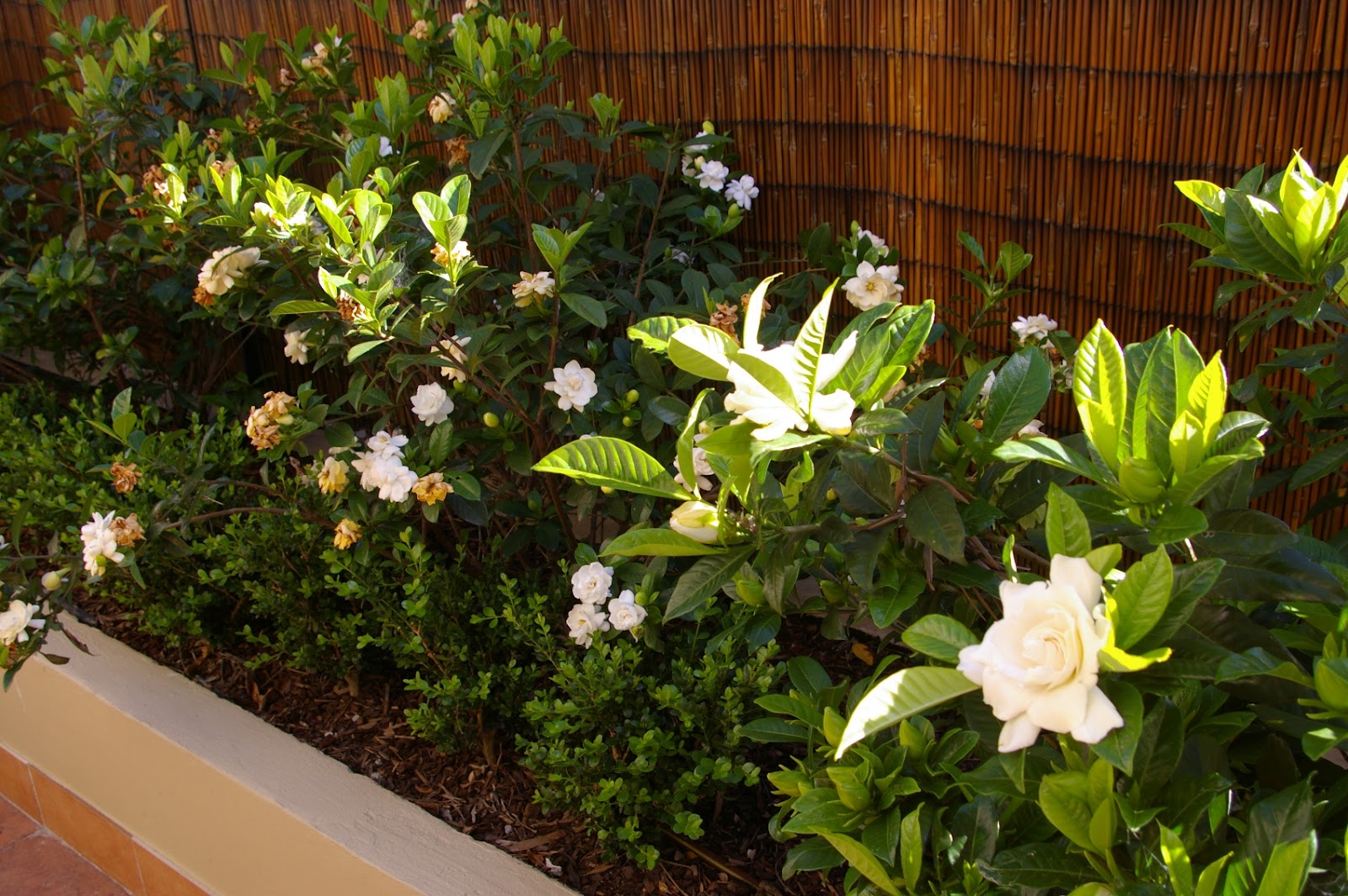
Also, this is not my part of the garden, but the bushes the owner has planted are flowering, and they smell lovely. Anyone know what kind of bushes these are? The big flowers start out white, then turn yellow before dying. The small flowers just bloom and then die.


Bad news:

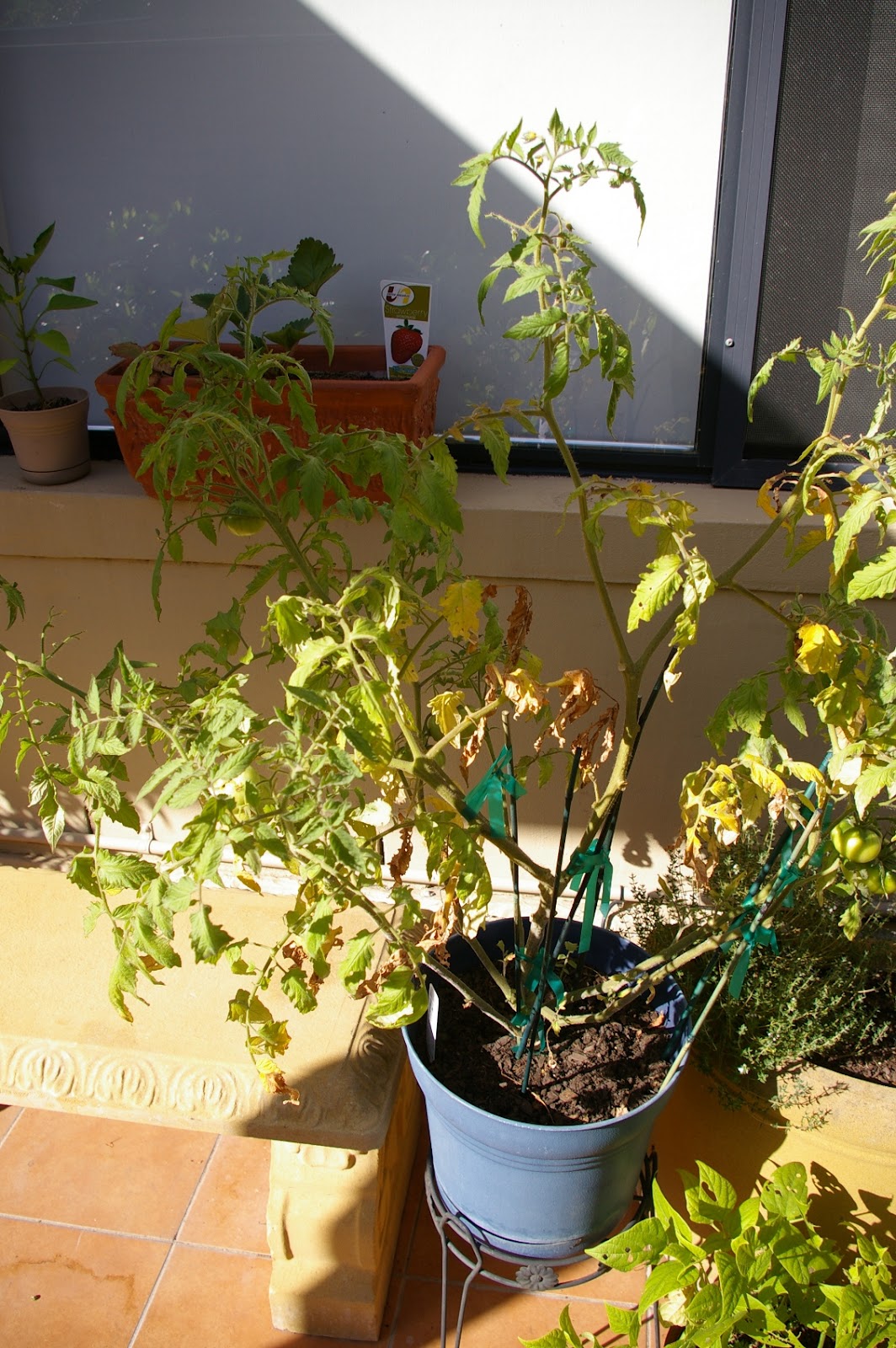
My tomato bushes look like this:


In particular, the large heirloom tomato is suffering. Even worse, I did some googling, and I think they have fusarium wilt, which comes from the soil and is not curable. I spoke with my coworker, who told me that all the potting soil here comes with lots of nematodes, which are the cause of the wilt.

Professor google also informed me that heirloom tomatoes are especially susceptible to the wilt, which explains why the big tomato looks even worse than the cherry tomatoes. At this point, I am desperately hoping that at least a few tomatoes redden up before the bushes die altogether. This is a huge disappointment to me, as it is the first year in ten (10!) that I have even attempted to grow my own tomatoes. Hopefully I get a few before I have to start over from scratch. At least it’s still technically spring here, so I can start over with fresh soil and fresh plants if necessary.

Update:  When I came home last night, I found that my heirloom tomatoes had finally bitten the dust.  We had some relatively strong winds yesterday and the plant was just not strong enough to withstand the breeze.   At least 2 branches with tomatoes are broken.  Of course, nothing had ripened, so I plan to have fried green tomatoes for dinner tonight.  Then, I'll dump the plant and dirt, sterilize the pot, and try, try again, this time with a disease-resistant variety.  So goes gardening, I guess.

Thursday, October 28, 2010

I Went to A Garden Party

One thing about living in an apartment with a courtyard is that I have no place for a garden. I want to get involved with the Randwick Community Garden, but I’ve been a little slow on that due to other commitments, and frankly, I don’t know if I want to take a plot when I don’t know how often I’ll be able to get over there. Anyway, the stop gap solution is to do some container gardening.

I’ve planted strawberries 


     tomatoes


basil


     thyme


peppers (on the right) and beans (on the left)


nasturtiums, which by the way, are an edible flower


    mint

and carrots.


So far the strawberries have been the big producer, yielding one whole berry. I have flowers on the tomatoes, so I’m really hoping they start producing something soon. I have already learned a few lessons, like I probably should have some more large pots, because I’m pretty sure I overcrowded the cherry tomatoes and the peppers.

I still wish I could have a real garden. In the meantime, this will have to do.

Update:  Since I originally wrote this post, there have been a few developments, mainly a few baby tomatoes.  So assuming they don't get eaten, we'll have tomatoes sometime in the next couple of weeks!  The bad news is, I have some sort of green caterpillar eating just about everything.  I need to get some organic remedies, because the caterpillar is really hard to find and pick off, which is my current method of prevention.  But at least I'm making some progress!

Thursday, October 14, 2010

Nor Any Drop to Drink

Today is Blog Action Day, a day in which bloggers worldwide write about a specific topic in order to raise awareness about a particular subject.  This year’s topic is Water.   Having recently moved from a water-rich location to one that is very sensitive to drought, my perspective on water has changed a little recently.

Australia has been suffering from intense drought over the past several years.  Many locations, including Melbourne and Sydney, have recently had water storage levels as low as 35% of their full storage capacity (the full storage level does not include floods).  This has resulted in many water restrictions and high water prices, as you might imagine.  Currently, a series of unusual rain events have raised the storage capacity to above 50% across New South Wales (Ref: National Water Commission).  The key word here is unusual – these rain events are not expected to continue on an annual basis.  While NSW has water now, in the very near future, we may be back to water restrictions.

One of the areas of New South Wales that is most affected by drought is the northwestern slopes area.  This area is at the headwaters of the Darling River, and a lot of cotton and rice is grown there.  As a result, the Darling frequently suffers from low water levels, high pollution and high salt content.  While I believe in locally made products, this makes me question whether I should buy rice and cotton products that are made in Australia.  Does it make sense to buy these products, which are grown in climatologically poor water areas?  Or should I buy products that are shipped from Asia, that don’t have as much of a negative impact on water levels, but are made by underpaid and poorly treated workers, and are shipped thousands of miles across the world, thereby using our precious fossil fuels and contributing to more carbon emissions?  I don’t think there’s any easy answer to this.

On a personal level, Ethan and I struggle with water conservation.  I have no idea how much water we use.  Back in Alaska, our landlord paid one fee for the building, so we never had to pay water useage.  Ethan loves baths, and I am constantly watering my flowers.  I also suspect that my methods of washing dishes waste a lot of water.  

Unfortunately, renting restricts some of the conservation measures I would like to take.  A rain barrel is not an option, because of the way our downspouts are built (can’t exactly cut into them).  A gray water system is completely out of the question.  We do have a dual flush toilet, but unfortunately, the half-flush just doesn’t work very well.  I’m hoping to take some more sustainability courses that might give me some clues as to how to reduce our water useage.  In the meantime, we will have to be more cognizant of our usage.  I’m sure our water bills over the next few months will make us more aware.

Saturday, October 09, 2010

The Worms Crawl In, The Worms Crawl Out

Alpha Monkey asked me in the comments about my worm farm, and I very rudely did not reply, because I planned to post on it.  With Ethan’s arrival, there have been some delays, but finally, I’ve gotten my act together.  

A worm farm is a method of disposing of your organic waste if you don’t have room for a compost pile.  Of course, if you do have a compost pile, you can still have a worm farm!  I took a free class on worm farming through the Waverly City Council, and received a free worm farm and 500 worms to start one at home. 
The worm farm has three levels.  The bottom level has a solid floor and is known as the “bathroom”.  The second level has a floor with holes in it and is known as the “bedroom”.  The top level also has a floor with holes in it and is known as the “kitchen”.  The lid has holes in it for air.   
Worm Farm

 Here is the worm farm all set up.  The tap in the bottom is for draining the worm farm when it rains so the worms don’t drown.  This isn’t a problem if you leave it under a covered area, like I have.

When the worm farm arrived, it had a solid block of coconut fiber in it.  I soaked this in water, and after a couple of hours, it had turned into a peat-like mass.  I put this in the “bedroom” for the worms.

The bedroom

Most of the time, the worms live in the bedroom, but they will travel up to the kitchen to eat the organic waste you leave for them.  Their waste falls through the bedroom to the bathroom, where it can be collected to apply to your plants.  It sounds kind of gross, but realistically, good dirt is pretty much made out of ground up minerals and worm poo.  

The worms eat a lot of things, like celery leaves, carrots, banana peels, hair from you or your dog, paper (such as your old receipts) and eggshells.  They will not eat oranges, lemons or onions.  It is also inadvisable to put meat or cheese in the worm farm, as this attracts other animals such as raccoons (in the U.S.) or possums (in both the U.S. and Australia).

Worms!
 
I had to let the worms settle in for about a week before I fed them.  Don’t worry, they were well fed at the worm nursery!  Today, I put a little bit of our organic waste in and covered it with an old cloth to deter flies and animals.  I’ll leave them to it, and check on them next week.  If I find worms in the kitchen, that means they’re eating the waste.  I hope this will be the case!

I was a little disappointed to find out that the worms are not very productive.  It will take them up to 6 months to produce enough waste to start putting it on my plants.  Obviously, this is more of a long-term investment than I thought!  Still, I thought it would be fun to get started with this, and when we leave, I’m sure it will not be too hard to find a good home for my worms.

Saturday, September 18, 2010

Bi-cycle, Bi-cycle, Bi-cycle

"I love to ride my bicycle...." --Queen

So today I had my free bike riding class, sponsored by Waverly Council. The city of Sydney is currently going through a transition to try to make their streets more bike-friendly, in the hopes that it will decrease the number of drivers, thereby reducing the congestion and the pollution. They have invested a fair bit of money on some new bike lanes on some of the major roads, and are sponsoring things like the free bike class. The class was called "Commute to Work by Bike" or something like that. The city has also sponsored a "Back on Your Bike" basics course, which I felt I was beyond.

I was the only attendee who showed up for the course. While that's a bit disappointing because I would like to see people taking advantage of these things offered by the city, it was cool because the instructor was able to tailor the course to me. First, we took a ride around the park and over towards my work so I could see some commuting route options. This was also a teaching opportunity, where my instructor would stop occasionally and talk about being aware of your surroundings -- things to watch for, ways to signal, etc. Then, we rode back to where we started and did some drills where I practiced looking behind me, making tight turns, and emergency stops. I learned some new techniques on all three of those, that I plan to practice on my quiet suburban street so that when I have to use them in real life, they come more naturally.

I was really impressed with my instructor, Geoff Nash. He was friendly, patient, and did a great job of building my confidence. I really liked the way he used our ride around the park for some real-life instruction. Geoff said that he wished Waverly Council would charge a nominal fee for the course, so that people wouldn't bail so frequently. After taking the course, I would gladly have a paid a fee. It was a lot of fun and I learned a lot. Too bad for all those other suckers that blew it off, but that was a definite benefit for me!

I'm going to see if I can get Ethan to sign up for one too, when he gets here.

Monday, September 13, 2010

Busy, busy, busy

I thought I would post a picture-less update of what I've been up to. I have some pictures, but I don't know when I'll get the chance to post them. My days at work are long -- 12 hours, and then an additional 30 minute bus ride/15 minute walk each way -- so in the evenings I'm pretty tired. Plus, I finally got my stuff, so I've been spending lots of time setting up the apartment. Anyway, here's what I've been doing:
  • I unpacked all the boxes and got the place pretty much set up. I still have a few pictures to hang, but overall, we're set.
  • Speaking of which, I have been pushing to do this before Ethan gets here in 9 (nine!) days!
  • I bought a bunch of seeds and vegetables and planted them in pots in my courtyard. So far I have cherry tomatoes, an heirloom tomato, a mix of green and red peppers, mint, thyme, rosemary, and basil, nasturtiums, carrots and dwarf beans. This will be my first attempt at growing veggies in pots, so we will see how it turns out.
  • I went hiking with some coworkers this past weekend to a nature reserve that's only open a few weekends a year. This was the last weekend for it, and they open it in the spring so you can see the bush in bloom. I have pictures of this I'll post later.
  • I went to a free class on worm farming, and got a voucher for a worm farm. The Randwick Council Nursery hasn't gotten the worm farms in yet, so I haven't picked it up. Maybe on Friday, or next week.
Upcoming:
  • Pick up the aforementioned worm farm
  • Pick up the aforementioned husband
  • Find time to visit Fievel in doggie jail (he is supposed to arrive Thursday, cross your fingers, everyone!)
  • A free class on commuting by bike. I will need to ride my bike to this; it's at a park in the middle of the city, so this will be an adventure for me. Plus, I am out of bike riding shape. It should prepare me to ride to work though, and once Ethan brings my new bike light from Alaska, I can try riding in to work.
Last week I also went out to dinner with my coworkers, and this week I'm invited to some friends' house for dinner as well. So I've been, and will be pretty busy. Good, because it will make the time until Ethan arrives pass more quickly!

I'll try to post again before Ethan arrives.

Friday, September 03, 2010

Going and Getting

I thought I would post about another kind of adventure today. Since moving to Sydney, I have been taking public transportation, with the exception of a few taxis. Although at first I was overwhelmed, I have found it not as difficult as I complained the first couple of weeks. So, for now, we have decided to try to do without a car.

Sometimes, you really need a car, though, like when you're visiting your dog in quarantine, or buying a worm farm from the local home improvement store. So I decided to join GoGet, a car-sharing scheme. There is a $25 application fee, a $500 deposit (refundable if you decide not to renew your contract) and a $70 insurance fee. Then you can pay $9 per month, and rent the car for $8.50/hr, or pay $25 per month and rent the car for $5.50/hr. I chose the first option, since I am not sure how much we'll be using it, and it's a lot easier to upgrade than downgrade. The cost included fuel, which is nice.

Today I decided to go on a worm-farm buying trip as a way of trying out GoGet before I pick Ethan up on the 22nd. I was disappointed when I got to the spot and the car was not there, but it gave me a chance to see how GoGet works. I called the toll free number, waited a minute, and talked to a very pleasant lady. She said she would call the previous user and call me back. Within 10 minutes, she returned my call. The spot had been full, so the previous user had parked elsewhere. Since they did not notify GoGet (a condition of the contract), they were fined, and I will receive a $25 "inconvenience" refund. Too bad for the previous user, but the contract does specify that you're supposed to call GoGet right away if you have a problem.

The car was a Yaris, and worked just fine. I had to refill it, and unfortunately the fuel card was missing, so I will be reimbursed later. Overall, it was a good experience, especially the customer service (which I find is not stellar in Australia). I hope I continue to be happy with the service.

Sunday, July 25, 2010

You Say You Want a Revolution

"...well you know, we all want to change the world." --John Lennon

I have some posts with pictures ready to go, but like I said, I'm waiting until I get real internet. Unfortunately, that won't be until next Thursday because I got my dates mixed up. If I have time, I will try to post from work. Otherwise, you'll have to wait for a week and half for more pictures, sorry.

In the meantime, I thought I would post a little something about an American trait I found I have, and sustainability/healthy living (which are close to my heart). I went out with a coworker and her friends the other night, and we started discussing Jamie Oliver's show "Food Revolution". This is a show where Jamie Oliver, a famous British chef, came over to the U.S. and delved into the inner workings of the school food system. As you all might remember, the public school food is pretty bad in the U.S. It's a lot of chicken nuggets and overcooked veggies (which not surprisingly, don't get eaten). But something about the show rankled a little bit with me, and I mentioned that the other night. I said that I found it a little bit irritating for some snobby British dude to come over and tell us everything that's wrong with our food system, and the lady who was talking about the show said "That's how all the other Americans felt. But don't you think it's better for him to come over and raise awareness?"

Now admittedly, I haven't seen the show. But here are my gut reactions: first of all, sorry, Great Britain, but you aren't on the list of the World's Skinniest People. So Jamie Oliver, maybe you should fix things in your own country before you go messing with others. Secondly, it's not like no one in America cares. There are lots of people who do care and are trying to do something about it, like this guy. But instead of interviewing people like that, who are working really hard and making progress, the television network thought it was appropriate to bring over a foreigner to tell us we're doing it all wrong. If I were an American like Ed Bruske, who had been working on the school lunch system for years, I would be pretty insulted and discouraged.

Of course, the network probably wants someone "famous" to do the show. Well, if they want someone famous, why don't they hire an American cook, like Rachael Ray (not that she's the healthiest cook ever, but you know what I mean)? Then, that person should interview the people who are trying to make things better to raise awareness. We are not a country of Neanderthals.

I think the other lady thought I was being a bit defensive. I thought about it a little bit, and I do think I am exhibiting a distinctively American trait: we like to tell other countries what to do, but we don't want foreigners all up in our business. Still, I wonder how it would fly if Jamie Oliver came over here and tried to tell Australians they were eating all wrong. As far as I can see, Australians are also pretty independent, and I think the show might go over like it did in the U.S.: like a lead balloon.